Control your enterprise interfaces before they control you!
Thursday 4th December 2025
Summary
How the Lucid protocol can help in managing interfaces in an enterprise and why that is important!
The Lucid protocol was developed by the Worldwide Industrial Telemetry Standards – Protocol Standards Association (WITS-PSA) as a complementary protocol to WITS-DNP3. But why did the WITS-PSA go to the trouble of developing a further protocol when they were already manage a well-established one? We have previously written an article which covers off many of the reasons, but this article drills into one specific reason: “controlling enterprise interfaces!”
What do we mean by enterprise interfaces
In the context of this article, we consider an enterprise to be a large organisation who have many OT (Operational Technology) systems. These systems might include telemetry systems, historians, asset databases, GIS, service desk software and the like.
Each of the systems will likely support interfaces with other systems either within or outside of the organisation; these interfaces might carry information about plant data and configuration for one or many SCADA data producers and consumers. As a water industry example, rainfall intensity data may be received from an external meteorological site. Collectively, all these interfaces are known as enterprise interfaces.
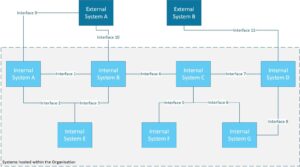
The enterprise architecture can be simplistically envisaged as shown in the diagram above, where there are several internal and external systems with different interfaces between them. Each of these interfaces will need to be understood by the organisation and then maintained and monitored to make sure they are behaving correctly. Note how the number of interfaces can grow quickly as the number of systems grows, especially if each new system supports multiple interfaces. Understanding and maintaining these interfaces is a cost to the organisation; minimising their impact can result in a significant reduction in OPEX.
The growth of interfaces in the enterprise
Organisations rarely stay still, and new regulatory requirements or business demands drive changes to the systems within organisations. Traditional Telemetry and SCADA systems are often slow to be adapted to these new demands. New turnkey systems which address these new business demands can often be accompanied with a compelling case for adoption. However, they may come with new interfaces and a requirement to integrate the system into the existing enterprise. The more interfaces that are adopted, the greater the burden on the organisation to manage those interfaces, educate people and create or modify procedures.
The consequence of many interfaces
Although new systems often provide an increased business benefit, they may require the adoption of a new interface. Below are some of the issues which arise with an increasing number of enterprise interfaces:
- Inconsistent information. Different interfaces for different systems will likely have different information included in the interface. Where information is the same, it may be presented in another format.
- Different frequencies of data change. Different standards and methods of operation may mean different frequencies of data change are seen from different system, leaving a problem of matching data between systems to be addressed in some other way.
- Increased technical debt. More interfaces to manage, results in an increase of the technical debt within the organisation.
- Higher maintenance and support costs. The organisation must implement and then maintain these interfaces, the greater the number of interfaces, the greater the implementation costs and the ongoing costs
- Wider training required. Staff will have to be trained on the new system and on its interfaces so that they can work on and maintain the system.
- Fewer appropriately skilled staff. A multitude of interfaces is likely to mean that fewer staff understand each interface. Staff retention may become more important to ensure that the system interfaces continue to be maintained, otherwise recruiting for the right skills might become an issue.
The effect of new systems on the OT department
OT departments provide resilient and reliable systems to run an organisation’s processes. They also often provide communications technology, data gathering, historian and visualisation functions. As the department who supports these systems, OT normally has to adopt other related new systems for ongoing support. This therefore means that the adoption of new systems can add considerably to the load borne by the OT department, especially if the adoption of the system is presented as a fait-accompli for the department and does not fit in with its existing practices.

OT departments usually implement one or more strategies to try and help them control the costs of managing many systems. New systems which promise business benefit may not always follow those strategies and if the OT department are forced to adopt them there can be costly issues in adoption and a reduction in the benefits provided by the department’s strategies. This has been described by some in OT telemetry as “the tanks of IoT and IIoT rolling up on the lawns of telemetry”, a reference to how powerless OT staff can feel, having to adopt systems which may not fit with their practices, but which the business wants.
Limiting the number of interfaces – Using Lucid
One way to avoid increasing the number of interfaces in use by an organisation, is to make use of a commonly available and easy-to-implement protocol, such as Lucid, for as many enterprise interfaces as possible. Lucid was designed for use within OT and should fit well within the organisation.
An OT department could adopt Lucid as part of its ongoing operational strategy. The organisation could then promote the Lucid protocol to system vendors, encouraging them to adopt the interface within their product as a means of easily integrating those into the organisation’s systems.
As Lucid is freely available and built with a low barrier to entry, vendors could be encouraged to use the interface. If Lucid is available as a system feature, it makes it easier for an organisation to both incorporate that system into an organisation’s enterprise, and to reduce the cost of maintaining the system’s interfaces.
Summary
The main considerations when trying to control enterprise interfaces are:
- It costs organisations to deal with many different enterprise interfaces.
- Adopting new systems for business benefit often adds to this enterprise interface burden.
- This may be more painful for the OT department who often end up having to manage the new systems.
- Setting out a strategy that promotes use of a single interface can lead to a reduced number of types of interfaces and therefore a reduced ongoing maintenance cost to the organisation.
- Lucid could be that single interface:
- It was designed for OT needs.
- It is free for vendors to use and implement.
- It has a low barrier to entry.
- It is easy to implement.
- It is commonly available.
Why not read more about Lucid – it could be the key to controlling your enterprise interfaces before they control you!
Mark Davison (Terzo Digital) and Dave Howarth (NWL)
December 2025
Terzo Digital and NWL have collaborated on a number of articles about Lucid in support of the protocol. You find find a list of those articles with a brief summary of their contents here.
Related articles
Articles · 6 minutes
What communications media will Lucid operate over?
Articles · 9 minutes
Lucid is much lighter than WITS-DNP3 – it was always meant to be
Articles · 7 minutes
Lucid vs WITS-DNP3 shootout
Articles · 12 minutes
Lucid Field Device Initial Configuration
Articles · 5 minutes
Lucid – The bare basics
Articles · 11 minutes
What managers should know about Lucid
Articles · 7 minutes
What does the Lucid protocol actually do?
Articles · 7 minutes